1740
ਭਾਈ ਸੁੱਖਾ ਸਿੰਘਭਾਈ ਮਹਿਤਾਬ ਸਿੰਘBhai Sukha SinghBhai Mehtab Singh
d. 1752d. 1745
Two men of the , remembered together for a single night in Amritsar in 1740.
Punjab, 1740
After the execution of Banda Singh Bahadur in 1716, the Sikhs of Punjab lived under a standing bounty. Zakariya Khan, governor at Lahore from 1726, put a price on Sikh heads and pressed the campaign hard through the 1730s. Many Sikhs left the plains altogether for the forests and deserts of the Malwa and Rajasthan, riding back only to raid. By 1740 the — the army of the elders, one of the two divisions the had organised itself into in 1734 — was sheltering in that desert country, far from Amritsar.
The two men
Bhai Mehtab Singh
BHAI MEHTAB SINGH was of Mirankot, a village eight kilometres north of Amritsar, a Jat Sikh of the Bhangu clan and the son of Hara Singh. As the persecution tightened he left his wife and his young son Rai Singh in the care of a village elder named Nattha, and went south to take service at Jaipur. He is sometimes called Mehtab Singh Mirankotia, for his village.
Bhai Sukha Singh
BHAI SUKHA SINGH was of Mari Kamboke in the Amritsar district, born into a family of carpenters of the Kalsi clan, to Bhai Ladha and Bibi Haro. He took initiation as a boy — young enough that his parents tried to hold him back from it — and rode with the of Sardar Sham Singh. He was already known in Punjab before 1740.
Almost everything recorded about them comes from one book, and from inside the family: the Prachin Panth Prakash, written by Rattan Singh Bhangu, who was Mehtab Singh's grandson.
The desecration
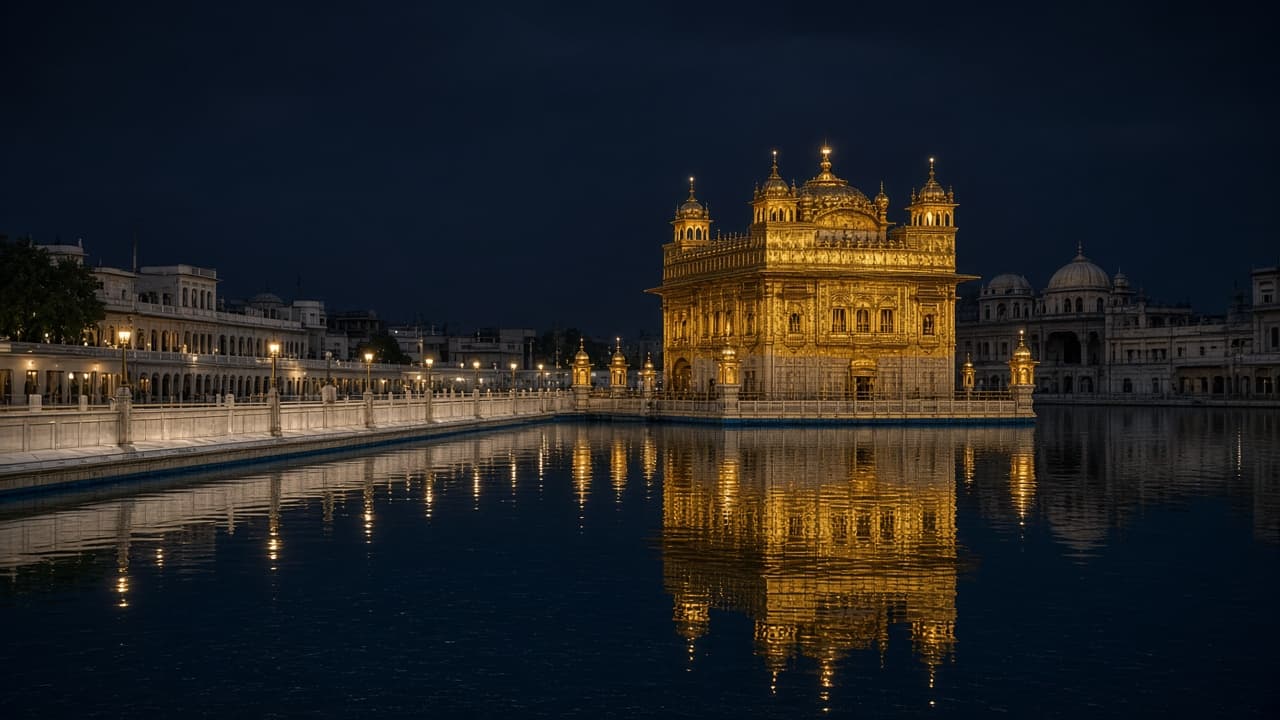
Massa Ranghar was the chaudhari of Mandiala, south of Amritsar. Zakariya Khan made him of the city with orders to keep the Sikhs away from their shrine. He went further than his orders. He occupied the itself, set his cot in the sanctum, and turned the inner precincts into a pleasure house — dancing performances, tobacco, drink, in the room the Sikhs held most sacred. No Sikh could come near the pool.
The vow
Word travelled south to the desert. A Sikh named Bulaka Singh carried the news to the . (Accounts differ on where it reached them: popular tradition says Bikaner, while Bhangu places Mehtab Singh at Jaipur, where he was in service.)
When the news was told, the put a question to the gathered Sikhs: who would go to Amritsar and answer it. Bhai Mehtab Singh stood up. Bhai Sukha Singh rose with him. They took two horses and rode north.
Amritsar, August 1740
They came into Amritsar in the middle of a scorching afternoon, disguised as revenue-payers riding in with the land tax. A dust wind was blowing hard enough that covering their faces drew no attention. They carried two bags that chinked like coin — tradition holds the bags were filled with broken pottery rounded to pass for money.
They tied their horses outside, at the ber tree where Lachi Ber now stands, and left their spears with them. They walked in with their swords under their arms.
Massa Ranghar was on his cot in the sanctum, listening to music. They set the bags down in front of him. As he leaned over to look at them, Bhai Mehtab Singh drew and struck his head from his shoulders; Bhai Sukha Singh held off the men in the room. They took the head, walked out through the noise, mounted, and were gone into the country before a pursuit could form.
(The date is usually given as 11 August 1740. One reference work gives 6 May. Bhangu, who is the closest source, gives only the season — the height of the rains — which fits August.)
Budha Johar
They rode back the way they had come, to the in the desert.
Sikh tradition holds that they presented the head at — a pond and camp in what was then Bikaner State, near the village of Dabla in present-day Sri Ganganagar district, Rajasthan, roughly three hundred and fifty kilometres from Amritsar. The place is said to be named for Jathedar Budha Singh, who was stationed there. The head was hung on a jand tree beside the water. That tree stood until about the year 2000; what remains of it is kept at Gurdwara Buddha Johad, which stands on the site today.
What came after
The reprisal fell on Mirankot. A force rode to the village looking for Mehtab Singh's family. Nattha, the elder who had taken the boy in, was killed defending him, along with his own son, his nephew, and two of his servants. Rai Singh was badly wounded and left for dead. He lived — and his son, Rattan Singh Bhangu, wrote the book this account comes from.
Bhai Mehtab Singh
BHAI MEHTAB SINGH was not found for five years. In 1745, hearing that Bhai Taru Singh had been arrested at Lahore, he came out of hiding and gave himself up so as to die alongside him. He was broken on the wheel in the Nakhas square at Lahore.
Bhai Sukha Singh
BHAI SUKHA SINGH lived another seven years and led his own . He fought at Eminabad in 1746 and was in the retreat from the Chhota Ghallughara that May, where a swivel-gun shot shattered his leg; he bound it to his saddle with his turban and brought the survivors across the Ravi, the Beas and the Sutlej to the Malwa desert. He raided, he fought a duel with an informer, he rode against Ahmad Shah Durrani's camp in 1748. In the first half of January 1752, foraging north of the Ravi during Durrani's third invasion, he met a much larger force. He and his men were killed to the last.